The use of natural gas has been an excellent alternative to produce relatively clean energy. There is more natural gas in the world than oil. Normally, natural gas is associated with oil and is obtained jointly or separately from it.
However, this gas has a problem just like oil, its origin is basically carbon stored for thousands of years which is released into the atmosphere producing heat energy that can be used to produce electricity in electric generators or turbines. This contributes to global warming, after burning natural gas there is more carbon dioxide in the atmosphere.
Various solutions have been sought, from burying carbon dioxide as carbonate to re-injecting it into oil wells.
Perhaps the most obvious is to work with nature and plant trees and bushes.
Photosynthesis captures carbon dioxide molecules and transforms them into structural organic molecules in plants. The energy source is sunlight. Nature has been doing this for millions of years and has a lot of experience.
Cactus biogas | Natural Gas | Liquefied petroleum gas | |||||
Origin | Sustainable, organic crops developed for energy production | Natural gas comes from the degradation of organic matter and is extracted from formations that may be found above oil fields or in independent reserves isolated from other raw materials. | Liquefied Petroleum Gas (LPG) has two origins: 60% is obtained during the extraction of natural gas and oil from the ground, while the remaining 40% is produced during the refining process of crude oil. | ||||
Main components | Methane 95%. Carbon dioxide, hydrogen and water | Methane: The main component of natural gas, with a percentage greater than 95%. Other hydrocarbons To a lesser extent, natural gas contains ethane, propane, butane, pentane and heavier hydrocarbons. Non-hydrocarbon gases Natural gas also contains small amounts of water, carbon dioxide, nitrogen and other substances not related to hydrocarbons. | It can be only propane, only butane or a mixture of both and in smaller proportions ethylene, propylene, butylene, pentane, among other substances, are also present. | ||||
Wholesale price | The average price of cactus biogas in projects on 400 hectares for 500 m3 is US0.40 /m3. | The average price of city gas for 500 m3 is US0.4231/m3 . In Chile | The price of vehicular LPG in the Metropolitan Region of Chile was US0.59 per liter in March 2024. | ||||
Investment | A project with cactus Biogas, plantations, machinery, facilities and all equipment included. It has an investment of 1.3 billion dollars to produce 10 million M3/day of Biogas at 95% methane, equivalent to natural gas. 130 dollars / m3/day produced | A platform requires 8,000-12,000 million dollars in investment to produce 10 million M3 of natural gas/day, which is an investment of 800-1200 dollars/M3 produced daily. | No information | ||||
Environmental impact | Biogas reduces greenhouse gas emissions. The biogas obtained is carbon neutral. | Natural gas is a non-renewable energy source that has a negative impact on the environment. | LPG is a non-renewable energy source that has a negative impact on the environment. | ||||
Uses | Cactus biogas can be used for residential, commercial, vehicular, and industrial activities. In your home, you can use it for heating water, cooking food, using dryers, refrigerators, central air conditioners, fireplaces, and dishwashers. | Natural gas can be used for residential, commercial, vehicular, and industrial activities. In your home, you can use it for heating water, cooking food, using dryers, refrigerators, central air conditioners, fireplaces, and dishwashers. | Gas commonly used in residential heating, cooking, and hot water systems, as a fuel in automobiles, and in industrial, agricultural, and manufacturing settings. |
Liquefied petroleum gas , also known as LP Gas or LPG, has been around since the early 20th century. Discovered as a byproduct of petroleum in 1900, it was initially used as a substitute for firewood for heating and cooking.
LPG is a mixture of gases, mainly butane and propane, originating from petroleum, widely used in cylinders for homes in various countries. The storage pressure is 15 bar (8 times the pressure of a car tire), at room temperature. Cylinders for home use are made of 1 mm steel
LPG is a gas composed mainly of butane and propane, which are obtained as a by-product in the petroleum distillation process.
LPG is a gas that is denser than air, so it tends to accumulate in low areas. This quality means that in some underground car parks it is forbidden to park cars with LPG, since any leak would accumulate in the basement and be dangerous. Natural gas, on the other hand, is less dense and tends to accumulate on the ceiling, but it is more easily dispersed with a ventilation system.
LPG is easier to liquefy. With relatively low pressures (around 10 bar) it is easy to store LPG in liquid form, taking up very little space. Natural gas, on the other hand, remains as a gas at pressures of up to 250 bar.
Liquefied Natural Gas (LNG) is natural gas in liquid phase at a temperature of -160ºC, which is why it is considered a cryogenic liquid. LNG is 95% methane (CH4) and contains smaller proportions of ethane, propane, butane, nitrogen and carbon dioxide.
Natural gas is obtained using a direct rotation drilling technique. During this procedure, the drilled material is transported to the surface through the interior of a drilling arm. The next step is extraction, which can be by ship (LNG) or through gas pipelines.
Biogas is a gas generated in natural environments or in specific devices, by the biodegradation reactions of organic matter, through the action of microorganisms (methanogenic bacteria, etc.), and other factors, in the absence of oxygen (that is, in an anaerobic environment). It is usually known as garbage gas or swamp gas due to its strong rotten egg smell, however, the smell comes from hydrogen sulfide in the degradation process, not from methane gas, which is colorless and odorless.
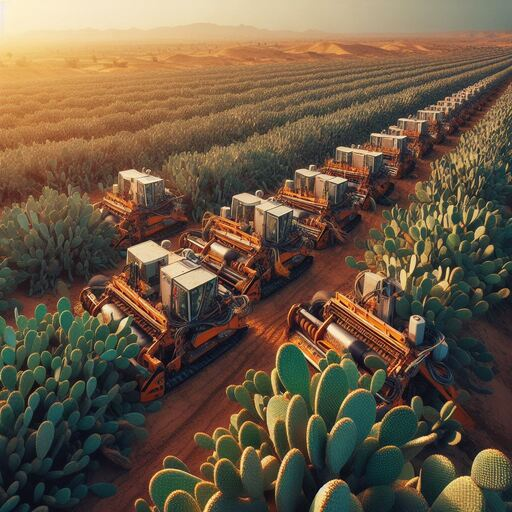
Biogas from biomass is a truly novel crop, perhaps the most promising on a large scale being the cactus or nopal. This desert plant can be grown in large arid areas where other vegetables will not grow.
Reforestation of deserts in North Africa and central United States is technically and economically possible. The use of this biomass for energy production using biodigesters has already been tested with excellent results.
Is investing in a cactus biogas plant 10 times cheaper than natural gas?
NG (natural gas) is often cited as an economical source of energy. But we can see this in numbers.
A platform requires 8,000 - 12,000 million dollars in investment to produce 10 million M3 of natural gas / day, this is an investment of 800 - 1200 dollars / M 3 produced daily.
A project with cactus Biogas, plantations, machinery, facilities and all the equipment including seawater desalination plants for crop irrigation requires an investment of 1.3 billion dollars to produce 10 million M3/day of Biogas at 94% equivalent to natural gas. 130 dollars/m3/day produced.
Here we have not yet considered the prospecting costs that a natural gas project must incur, which have uncertain outcomes and are generally quite expensive.
The cactus grows not only in deserts but also in more temperate areas from southern Spain to Cape Town in South Africa. The incredible adaptation to diverse climatic conditions and scarce rainfall makes it an extraordinary alternative for producing food and energy.
Poor and desert countries, most of them with coastlines, can transform their economies by producing their own fuel at a lower cost than natural gas.